Unlocking Connection: Busting AAC Myths with Dr. Lindsay Kaffl
Why alternative communication tools aren’t a “last resort” and how they help young children find their voice.
Meet the Expert
If you’ve ever felt overwhelmed by the endless sea of advice around childhood communication, you’re not alone. Few people understand that journey quite like Dr. Lindsay Kaffl, SLPD, CCC-SLP, ATP.
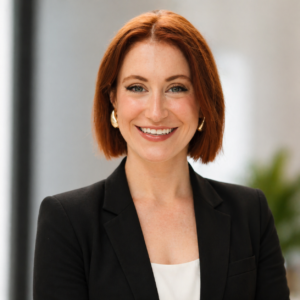
As Director of Speech-Language Pathology at Children’s Specialized ABA, Dr. Kaffl brings a rare blend of deep clinical insight and researcher curiosity to her work. Holding a Doctorate in Speech-Language Pathology from Kean University and dual licensing in NJ and NY, she is also a RESNA-certified Assistive Technology Professional (ATP), which means she specializes in bridging the gap between traditional speech support and modern communication tools.
Whether she’s presenting research at national conventions, such as her work on the intersection of Autism and AAC software at the 2025 ASHA convention, or helping a toddler communicate during snack time, her goal remains the same: helping every child find their unique voice.
We sat down with Dr. Kaffl to talk about Augmentative and Alternative Communication (AAC), dismantle the biggest misconceptions holding families back, and share simple ways to build connection at home.
A Conversation with Dr. Lindsay Kaffl
Q: When parents first hear the term “AAC device,” what is the most common hesitation or fear you hear?
Dr. Lindsay Kaffl: The single biggest fear we hear from parents is that introducing an AAC device or communication board will prevent or delay spoken language. Parents naturally worry: “If my child has a screen or picture system to talk for them, will they just stop trying to use their verbal voice?”
In reality, the exact opposite happens! Research consistently shows that AAC actually supports and increases spoken language. When a child uses an AAC system, they receive clear visual and auditory feedback. That extra input gives their brain another way to process language, which often makes it easier for them to produce spoken words themselves down the road.
Q: Let’s run through a rapid-fire myth buster. What are some of the biggest AAC misconceptions you’d love to retire for good?
Dr. Kaffl: I could list so many, but here are five big ones we run into all the time:
Myth 1: “AAC is only a last resort when speech therapy fails.” > The Truth: AAC should be considered whenever a child’s current communication isn’t meeting their daily needs. Providing support early allows children to engage, learn, and socialize right now, rather than sitting on the sidelines waiting for speech to emerge.
Myth 2: “My child needs to master prerequisite skills, like picture matching, before using AAC.” > The Truth: Communication access should never be held hostage while waiting for specific benchmarks. Kids learn language by using language. They don’t need to pass a test first.
Myth 3: “A child has to be a certain age to start.” > The Truth: There is no minimum age requirement! Even very young toddlers can learn to use symbols, gestures, and simple speech-generating devices. Early childhood is when the brain is most responsive to language learning, so earlier is always better.
Myth 4: “High-tech electronic devices are always better than low-tech tools.” > The Truth: While tech tools are very popular, “better” is completely personal. The best AAC system is simply the one that meets your child’s specific day-to-day needs, whether that’s a high-tech tablet or a simple paper communication book.
Myth 5: “Using AAC means we’re giving up on verbal speech.” > The Truth: AAC is an addition to a child’s toolbox, not a replacement. Think of it like adults: we text, email, use hand gestures, make facial expressions, and speak out loud depending on the situation. AAC just gives children multiple ways to express themselves.
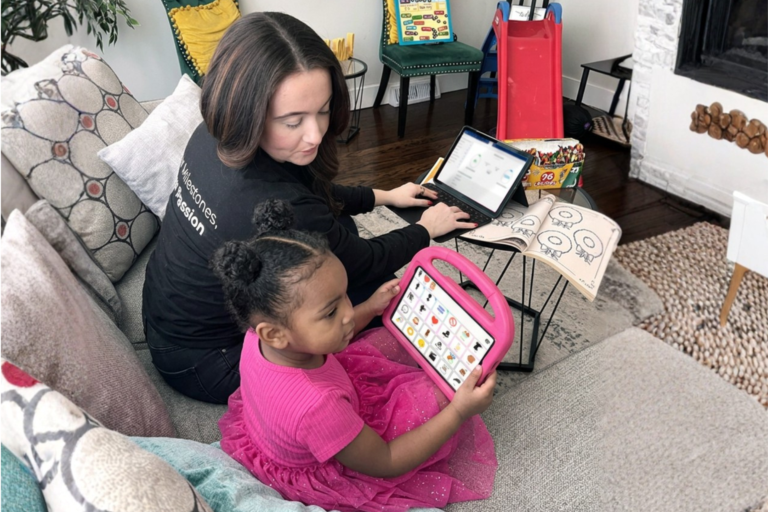
Q: What usually changes in a home once a family takes the leap and introduces an AAC system?
Dr. Kaffl: It is often transformative. Once children have a reliable way to get their message across, we typically see:
- A drop in frustration: So many challenging behaviors stem from communication breakdowns. When kids can express what they need, the tension melts away.
- More active participation: Kids start jumping into family conversations, school activities, and play sessions because they finally have a seat at the table.
- A surge in confidence: Parents tell us all the time that their child seems happier, more independent, and eager to interact.
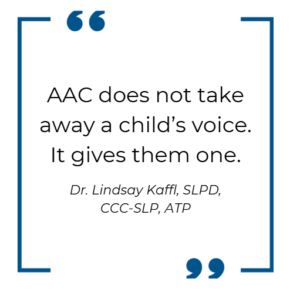
As speech-language pathologists, we always say: AAC does not take away a child’s voice. It gives them one. Once parents see that connection happen, they usually stop worrying about the device and wonder why they didn’t start sooner!
Q: For families just starting out, how can they introduce an AAC tool without it feeling like “homework” or an extra chore?
Dr. Kaffl: Keep it natural! The best AAC learning happens during everyday life, not during formal “practice time.” Pick moments that are already happening, like mealtime, getting dressed, or bedtime books, and simply model a few words on the device as you talk.
- At snack time: Tap words like “eat,” “more,” or “all done.”
- During play: Tap “go,” “stop,” or “turn.”
- At bedtime: Tap “book,” “goodnight,” or “sleep.”
You don’t need to press a button for every single word you say out loud. Touching just 1 to 3 key words while speaking naturally shows your child how the tool works. Above all, view the device as their words, not a test to pass.
Q: What is one final piece of encouragement you’d offer to a parent feeling overwhelmed by the process right now?
Dr. Kaffl: Remember that progress is meant to be a slow and steady growth journey for your entire family, and it doesn’t need to happen overnight!
Start small. Focus on a few meaningful words during activities your family already enjoys. Celebrate every single communication attempt, whether it happens through the device, a verbal sound, a gesture, or a smile.
At the end of the day, progress isn’t measured by how many buttons a child can press. It’s measured by their growing ability to connect with you and share what’s on their heart.
How Children’s Specialized ABA Can Help
Communication is just one piece of your child’s developmental journey. At Children’s Specialized ABA, we believe in a whole-child approach to autism care, meeting your family where you are with individualized support tailored around your daily routines.
Whether your child benefits from structured center-based learning or the comfortable, familiar surroundings of home, our expert team is here to support your family with:
- Integrated Speech Therapy: Delivered alongside ABA therapy in our early intervention centers to build language, articulation, and social communication skills.
- In-Home ABA Therapy: Flexible, home-based care designed to naturally weave skill-building into everyday family life.
- Comprehensive Care: Collaborative therapy options, including Occupational Therapy and family guidance, that support your child’s total well-being.
Ready to take the next step in your child’s communication journey? Explore our Speech Therapy services and whole-child autism care options, or reach out to the Children’s Specialized ABA team today to connect with a specialist.
About Children's Specialized ABA
Children’s Specialized ABA provides comprehensive, whole-child autism care across New Jersey, Maryland, North Carolina, and Arizona. In partnership with RWJBarnabas Health, our mission is to provide a safe, nurturing space that empowers children on the autism spectrum to reach their full potential and thrive in their everyday lives.