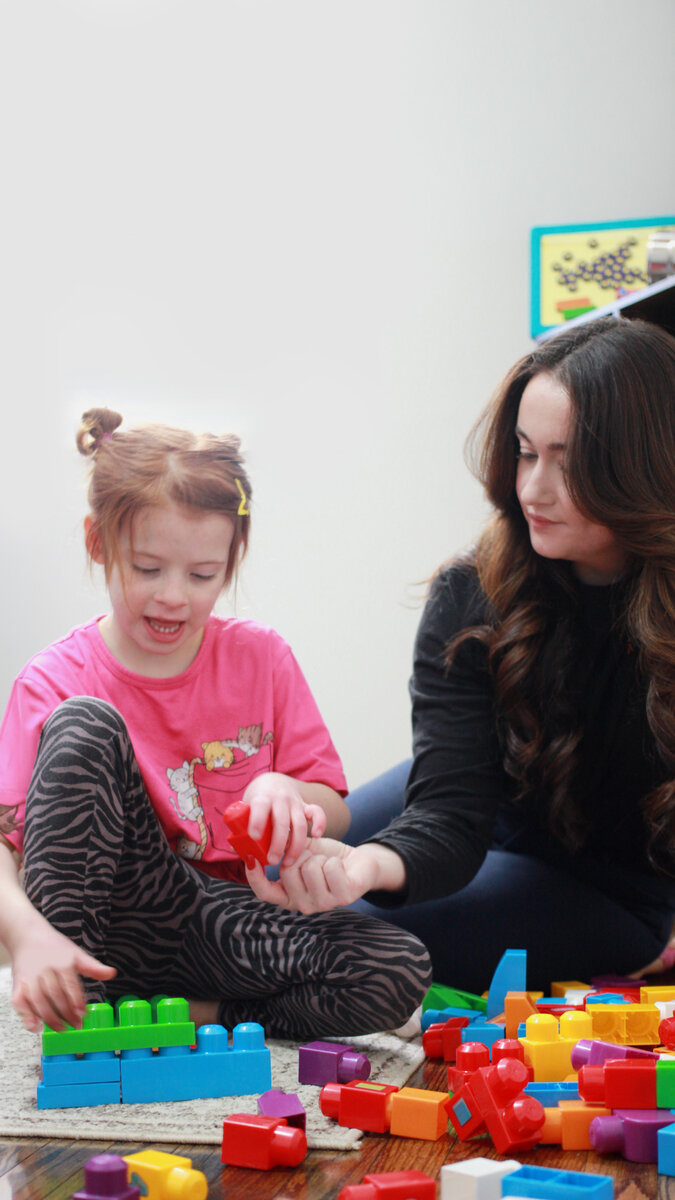
What Is In-Home ABA Therapy?
In-home ABA therapy means a Board Certified Behavior Analyst (BCBA) and Registered Behavior Technician (RBT) come to your house. The therapist works with your child in familiar surroundings: your living room, kitchen, backyard, or wherever the therapy plan calls for practice. Sessions typically run 10-25 hours per week, with multiple technicians rotating through your home.
The BCBA designs a treatment plan specific to your child’s needs, then technicians execute that plan during in-home sessions. You, the parent, are present. You learn strategies during each session. You practice them between appointments. Your home becomes the classroom.
This model works because children often learn and generalize skills faster in natural environments. Playing with toys at home feels more authentic than a clinic playroom. Practicing communication at the dinner table transfers directly to family life. When your child masters a skill in the kitchen, they’re ready to use it there, not relearning it elsewhere.
Children’s Specialized ABA coordinates all of this. We send the same technicians when possible so your child builds consistency. We make sure you understand what’s happening so you’re reinforcing progress at home even when the therapist isn’t there.
How many hours per week is typical for in-home ABA?
Most in-home programs range from 10 to 25 hours per week, depending on your child’s age, diagnosis, and family needs. Some families start with 10 hours and scale up. Others begin with intensive 25-hour-per-week programs. Your BCBA recommends the level based on your child’s assessment, not a one-size-fits-all template.
Will in-home ABA disrupt my family’s routine?
Not if you plan for it. Therapists integrate into your existing schedule. Some families block out afternoons for ABA. Others prefer mornings before school or evenings. You have flexibility in timing because the therapy happens at your home, not on a clinic’s schedule. That said, having a technician in your home 15-25 hours per week does require adjustment. Many families find this worthwhile because they’re watching therapy happen in real time and learning alongside their child.
What Is Clinic-Based ABA Therapy?
Clinic-based ABA therapy happens in a dedicated therapy center. Your child travels to the clinic, works with a technician in a therapy room designed for ABA, and returns home. Sessions are scheduled appointments, much like visiting a pediatrician’s office.
Clinic-based programs use the same ABA principles as in-home therapy. The BCBA designs a plan. Technicians deliver it. Your child practices skills and works toward goals. The difference is location, routine, and how you participate.
Clinic settings offer structure. The therapy room has limited distractions, no pets, no siblings running around, no random toys to pull attention away. For some children, especially those sensitive to sensory input or prone to elopement, this focused environment accelerates learning. The clinic becomes a predictable space where your child knows what to expect.
In a clinic, your child also practices functional skills like waiting in a waiting room, transitioning between activities, and following a schedule. These generalize to other settings: schools, doctor’s offices, restaurants. Some children thrive in this semi-structured environment. Others find it isolating or anxiety-provoking.
You attend some sessions as an observer and receive training from the BCBA, but you’re not present during all therapy hours. The technician takes primary responsibility for the session while you wait or pick up your child afterward.
Can my child attend clinic-based ABA while still going to school?
Yes. Clinic sessions are scheduled around school hours. Many families do late afternoons or early mornings before school. Weekend sessions are also common. This model gives you flexibility that feels less invasive than in-home therapy filling your weekday afternoons.
Is my child less engaged in a clinic setting?
Not necessarily. A skilled RBT creates engaging sessions using positive reinforcement, games, and age-appropriate activities. Some children actually prefer the clinic because it signals “therapy time” and keeps home life separate. Others get bored or anxious being away from parents. Your child’s temperament matters here.
Cost, Insurance, and What New Jersey Covers
Both in-home and clinic-based ABA are covered by most New Jersey insurance plans, including Medicaid/NJ FamilyCare. This is a major relief for families. However, coverage details and out-of-pocket costs vary.
In-home ABA costs more operationally because therapists travel, coordinate schedules, and spend one-on-one time with your child. Your insurance plan covers most or all of this under ABA therapy benefits, but you may have co-pays or deductibles.
Clinic-based ABA typically has lower operational costs, no travel, shared space, potentially more efficient scheduling. However, your insurance plan may classify it differently than in-home services, leading to different coverage levels.
New Jersey’s FamilyCare program (Medicaid for children) covers ABA therapy without a lifetime benefit cap, which is excellent news. Coverage is contingent on medical necessity, your child must have a diagnosis supporting ABA services. Both in-home and clinic models are covered.
Here’s the critical step: before committing to either model, contact your insurance provider or have Children’s Specialized ABA’s billing team verify your coverage. We handle insurance verification and coordinate benefits so you understand costs upfront. Some families discover they have minimal out-of-pocket costs; others budget for a small monthly co-pay. Knowing early prevents surprises.
Generalization, Learning Environments, and Where Skills Stick
ABA works through a principle called “generalization.” Your child learns a skill in one setting, then applies it in another. A therapist teaches your child to request a drink at the clinic. Your child goes home and requests a drink at dinner. Generalization, skill transfer across environments, is the goal.
In-home ABA has a natural advantage here. Your child learns to request in the kitchen, practices it at meals, and generalizes within the actual context of family life. There’s no translation step. The skill is immediately useful at home, and parents reinforce it constantly.
Clinic-based ABA requires intentional generalization planning. The BCBA designs exercises that mimic home and school scenarios within the clinic, then you and teachers reinforce the skill outside the clinic. This works, but it takes explicit programming and coordination across settings.
Neither model is “better” at generalization. In-home therapy is more efficient for home-based skills. Clinic-based therapy is efficient for skills practiced in structured, distraction-free settings first, then generalized outward.
If your child struggles with transitions or needs intensive, focused practice on fundamentals before applying them at home, clinic-based ABA may accelerate foundational learning. If your child learns best through natural routines and family involvement, in-home ABA is often faster.
My child is nonverbal. Which model helps more with communication?
Both support communication development. In-home ABA has the advantage of practicing communication in the contexts where your child actually needs to communicate: asking for food, requesting play, expressing discomfort at home. Clinic-based ABA supports communication in structured practice, then generalization planning brings skills home. Many families use a hybrid: clinic-based for structured practice, reinforcement at home. Discuss this with your BCBA.
Family Involvement and Parent Training
In-home ABA embeds parent training into every session. The technician explains what they’re doing, models strategies, then watches you practice. Over weeks and months, you become skilled at recognizing behaviors, using prompts, and reinforcing progress. Parents often report they understand their child’s learning profile better through in-home therapy.
Clinic-based ABA includes parent training too, but it’s often scheduled separately or at the beginning/end of sessions. You attend periodic meetings with the BCBA to discuss strategies, but you’re not present during most therapy hours. This can feel more distant, though many parents find it helpful to have “therapy time” separate from home.
Both models emphasize parent involvement. ABA research is clear: the more parents understand and reinforce progress at home, the faster children progress. Neither model can succeed without engaged parents. The question is whether you prefer learning during sessions (in-home) or in scheduled meetings (clinic).
Making Your Decision
Here’s how to choose:
Want to understand the differences more? Learn about our clinic-based therapy programs and how they compare to in-home services.
Choose in-home ABA if:
- Your child needs intensive hours per week and you have space at home
- You want to learn therapy strategies firsthand and be involved in every session
- Your child’s goals are heavily home-based: family communication, self-care routines, sibling interaction
- You prefer consistency (same technicians, familiar environment)
- Your child is very young and benefits from natural learning environments
Choose clinic-based ABA if:
- Your child needs a structured, distraction-free environment to focus and learn
- You prefer to separate therapy time from home life and family routines
- Your work schedule makes regular home visits difficult
- Your child benefits from peer observation or clinic-based social programming
- You want less invasive scheduling in your family’s week
Consider hybrid ABA if:
- Your child benefits from both models: intensive clinic sessions for skill building, plus lighter in-home reinforcement
- You want structured practice with generalization homework
- Your budget allows for a blend of both
Children’s Specialized ABA partners with RWJBarnabas Health to deliver both models throughout New Jersey. Our team helps families weigh these factors, assess your child’s needs, and transition between models if needed. Most importantly, we’re honest: some families change their minds after 3-6 months. That’s fine. We adjust the plan and ensure your child’s progress doesn’t stall.
Your decision doesn’t have to be permanent. The right model today might not be the right model in a year. Flexibility matters.
Next Steps
Ready to explore in-home or clinic-based ABA for your child? Contact Children’s Specialized ABA to learn about in-home ABA therapy services in New Jersey. We’ll discuss your family’s situation, your child’s needs, and schedule a free consultation with a Board Certified Behavior Analyst.
Your child’s path forward starts with the right support, in the right setting, at the right time. Request a free ABA assessment today.