Introduction
There’s a moment every parent of a minimally-verbal or nonverbal child dreads: someone asks, “Does he/she talk?”
The question itself carries weight, an implicit assumption that speech equals intelligence, capability, or worth. It doesn’t.
Children who are nonverbal or minimally-verbal are not less intelligent, less capable, or less worthy of inclusion and respect. They simply communicate differently. And with the right support, they can express needs, wants, ideas, and emotions, just maybe not through spoken words.
This guide walks parents through supporting communication in children who are nonverbal or minimally-verbal, exploring all the ways humans communicate beyond speech.
Understanding Nonverbal and Minimally-Verbal Autism
Definitions
Nonverbal: Child does not speak in functional words or phrases. This doesn’t mean they make no sounds, they might be very vocal, but words aren’t used communicatively.
Minimally-verbal: Child speaks, but with limited vocabulary (typically <50 words) or limited functional use. May use words, but not in conversation or with consistent meaning.
Important note: Both nonverbal and minimally-verbal children often understand far more language than they can express. Expressive language (what they say) lags significantly behind receptive language (what they understand).
Why This Happens in Autism
Several factors affect whether a child develops spoken language:
- Motor speech planning difficulties (like childhood apraxia of speech)
- Language processing differences affecting word formation
- Social communication differences reducing motivation to speak
- Sensory sensitivities to speech sounds or oral input
- Motor control challenges affecting mouth muscles
- Co-occurring intellectual disability affecting all language domains
- Combination of the above
Importantly, intelligence is not the limiting factor. Many nonverbal children have average to above-average intelligence but face motor, processing, or neurological challenges affecting speech output specifically.
Communication Happens in Many Forms
Parents often focus exclusively on speech because that’s what society values. But humans communicate through:
Spoken Words
- Single words (“more,” “help”)
- Phrases and sentences
- Conversation and storytelling
Sounds and Vocal Noise
- Echolalia (repeating words, phrases, or scripts)
- Singing or humming
- Vocalizing emotions (joy, distress)
Body Language and Gesture
- Pointing to request or direct attention
- Head shaking or nodding
- Facial expressions
- Hand movements and gestures
Sign Language
- ASL (American Sign Language)
- Signed English
- Home signs created by family
Visual Communication
- Picture boards or PECS (Picture Exchange Communication System)
- Written words or texts
- Drawing or pointing at images
AAC (Augmentative and Alternative Communication)
- Low-tech: picture boards, communication notebooks
- Mid-tech: voice-output devices
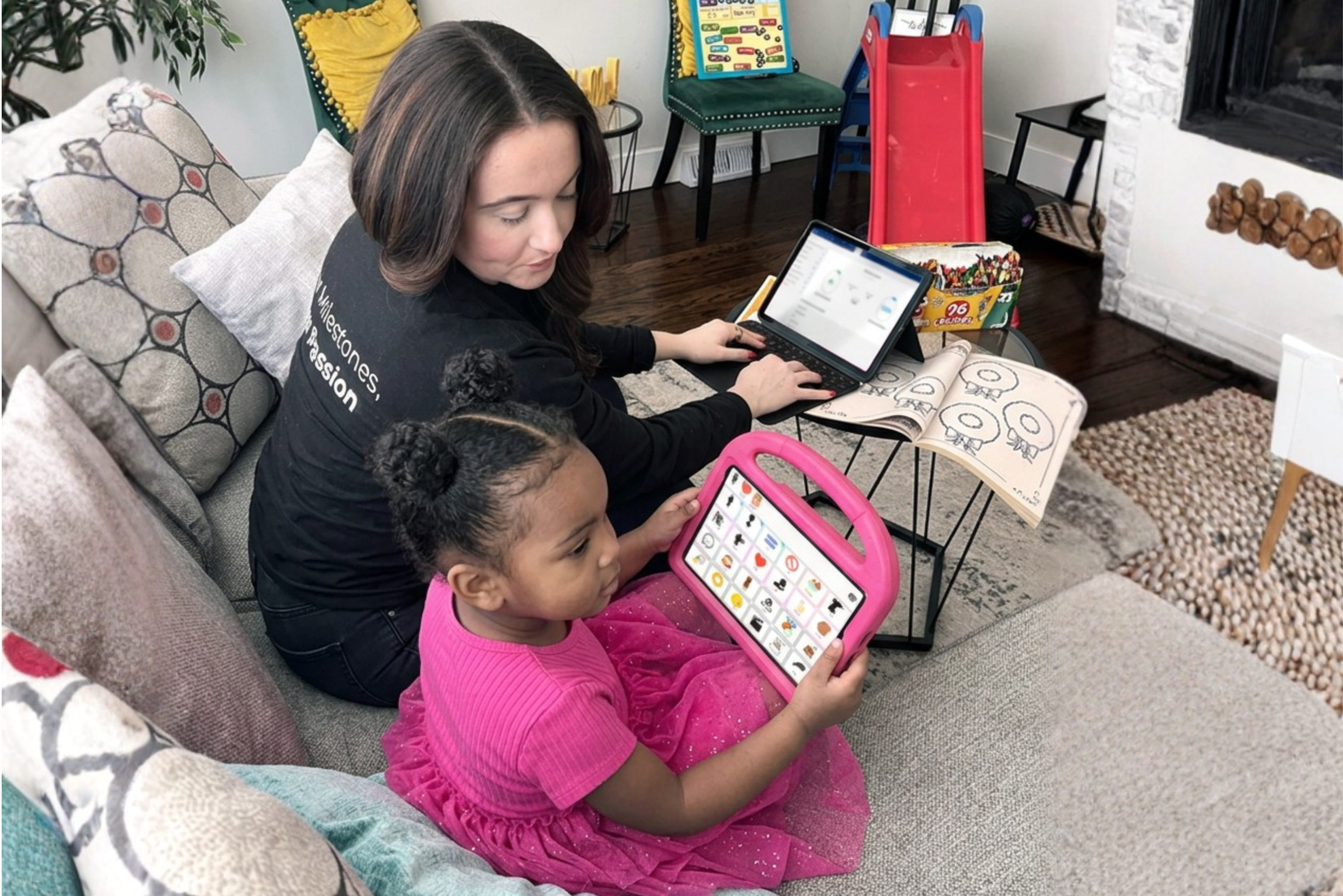
- High-tech: iPad apps like Proloquo4Text, JABtalk, or AAC apps
- Eye-gaze systems for children with severe motor challenges
Behavior
- Yes, behavior communicates. Banging a door means something. Running to the kitchen means something. These are valid communication attempts.
The Power of AAC
One common misconception: “If I give my child AAC, they won’t try to talk.”
This is false. Research clearly shows that AAC supports speech development and doesn’t inhibit it. Children who use AAC often:
- Develop more words overall (spoken + AAC)
- Improve speech production through consistent practice
- Reduce frustration, leading to fewer behavioral challenges
- Build confidence in communication
- Some eventually develop functional speech
AAC is not a replacement for speech therapy, it’s a support that removes the barrier of motor speech difficulty.
Choosing an AAC System
Low-Tech (Pictures)
- Pros: Affordable, customizable, portable, no technology
- Cons: Limited vocabulary, slower to use, requires physical proximity
- Best for: Early communication, specific contexts, backup systems
Mid-Tech (Voice Devices)
- Pros: Portable, voice output, reasonable cost
- Cons: Limited vocabulary, can’t be customized as easily as apps
- Best for: Specific settings, children who benefit from hearing words
High-Tech (AAC Apps)
- Pros: Unlimited vocabulary, voice customization, growing/learning, can use at home and school
- Cons: Requires iPad/tablet, learning curve, cost of apps
- Best for: Children with good motor control, those who’ll use daily
Eye-Gaze
- Pros: No hand control required, access for severely motor-impaired
- Cons: Expensive, requires training, tech support needed
- Best for: Children with cerebral palsy or severe motor challenges
How ABA Supports Nonverbal Communication
ABA therapists are trained to teach communication in any form:
Teaching Requesting
- Using gestures, vocalizations, or AAC
- “Manding” (requesting for desired items or activities)
- Building motivation so the child wants to communicate
- Reinforcing every communication attempt
Teaching Social Communication
- Joint attention (looking where someone points)
- Turn-taking in play and conversation
- Initiating interaction with others
- Responding to social bids from peers
Reducing Challenging Behavior
- Recognizing behavior as communication
- Teaching alternative communication (when behavior emerges, teach the better way)
- Building skills that reduce frustration
- Creating predictability and routine
Fostering Generalization
- Teaching communication across people, settings, and contexts
- Ensuring skills learned in therapy show up at home and school
- Building independence in communication attempts
Supporting AAC Use
- Incorporating AAC devices into therapy
- Modeling AAC use consistently
- Building motivation to use the device
- Troubleshooting when the child avoids the device
What Progress Looks Like for Nonverbal Children
Progress for nonverbal children looks different, and that’s okay.
Early Progress
- Increased communication attempts (vocalizations, gestures, or AAC)
- Reduced frustration (because communication is now possible)
- More back-and-forth interaction
- Understanding that they can make things happen through communication
Medium-Term Progress
- Expanded vocabulary (however expressed)
- Increased spontaneous communication
- Better use of available communication methods
- Emerging word approximations or vocalizations
- More independence in daily routines
Long-Term Progress
- Some may develop functional speech
- Others become fluent AAC users
- Many use multimodal communication (speech + gestures + AAC)
- Increased independence and quality of life
- Meaningful relationships and inclusion
The Reality Check
Not all nonverbal children develop speech. Some remain nonverbal or minimally-verbal into adulthood. That’s okay. A nonverbal child who can communicate needs, preferral programences, and ideas through AAC and gesture is infinitely better off than a nonverbal child with no reliable communication system.
Creating a Communication-Rich Environment at Home
Use Total Communication
- Speak to your child (even if they don’t speak back)
- Use gestures and signs
- Point to pictures
- Use AAC alongside speech
- Respect all forms of communication
Build Motivation
- Communicate about things your child cares about
- Use motivating items (preferred snacks, toys, activities)
- Make communication necessary for desired outcomes
- Celebrate every attempt
Provide Opportunities
- Open-ended play where your child can request
- Pause and wait for communication attempts
- Don’t always anticipate needs
- Leave gaps for your child to fill
Consistency Across Environments
- Use the same communication method at home, school, and elsewhere
- All caregivers should understand the system
- Reinforce communication attempts consistently
- Progress is faster when everyone uses the same approach
School Considerations
Advocating for AAC in School
- Request AAC assessment if not already done
- Include AAC in your child’s IEP (Individualized Education Program)
- Ensure the device goes to school daily
- Ask for staff training on the AAC system
- Monitor that the school actually uses it in instruction
Collaboration
- Work with speech-language pathologists
- Share progress and challenges at home
- Ask for carryover activities
- Ensure consistent expectations across settings
Supporting Your Child’s Identity
This Matters
- Nonverbal and minimally-verbal individuals often have strong feelings about their disability, communication, and identity
- Treat communication differences with respect
- Avoid speaking negatively about your child’s ability to communicate
- Include your child in conversations about them (even if they’re nonverbal)
- Assume competence, they understand more than they can express
Connect With the Community
- Many nonverbal and AAC-using individuals now share their experiences online
- Hearing from adults who use AAC can inspire hope and perspective
- Support organizations for nonverbal autism and AAC
- Remember: your child has value exactly as they are
The Bottom Line
A child who cannot speak can still learn, grow, love, feel, and communicate. They can share their needs, preferences, and joy with the world, just maybe through different channels.
Your job as a parent is to:
✓ Accept your child’s communication style
✓ Provide every tool available (speech therapy, AAC, visual supports)
✓ Build confidence in communication
✓ Create opportunities for meaningful interaction
✓ Celebrate progress in whatever form it takes
✓ Treat your child with the dignity and respect they deserve
Progress might look different than you expected. But progress is still progress, and every bit of increased communication, whether spoken, signed, gestured, or via AAC, is worth celebrating.
Key Takeaways
✓ Nonverbal ≠ unintelligent; it’s a motor or processing difference
✓ Communication happens through many channels, not just speech
✓ AAC supports (not replaces) speech development
✓ ABA therapists teach communication in all its forms
✓ Consistency across environments accelerates progress
✓ Progress looks different but is equally valuable
✓ Your nonverbal child has a voice, sometimes we just need different equipment to hear it
Is your nonverbal or minimally-verbal child struggling to communicate? Our team can help. We’ll assess what communication methods work best for your child and build a plan to increase meaningful interaction and independence.
Related Articles:
– [Childhood Apraxia of Speech and Autism: Understanding Therapy and Progress]
– [ABA vs. Speech Therapy: Which Is Best for Your Child?]
– [How to Support Communication in Children With Autism]
This article is for informational purposes and should not replace professional evaluation or therapy. Consult with a speech-language pathologist for communication What to Expect During Your Child’s ABA Assessment .
Meta Description (160 characters): Support nonverbal and minimally-verbal autistic children. Learn communication methods beyond speech, AAC options, and how ABA builds language skills.